
The AI Value Shift: MGS Elevates Supply Chain Resilience and Efficiency
As the cost of foundational AI models declines, the true competitive edge in supply chain software is shifting. This brief explores how differentiation is moving towards deep workflow ownership, contextual data, robust integration, and decisive execution authority, and how MGS empowers organizations to thrive in this evolving landscape.
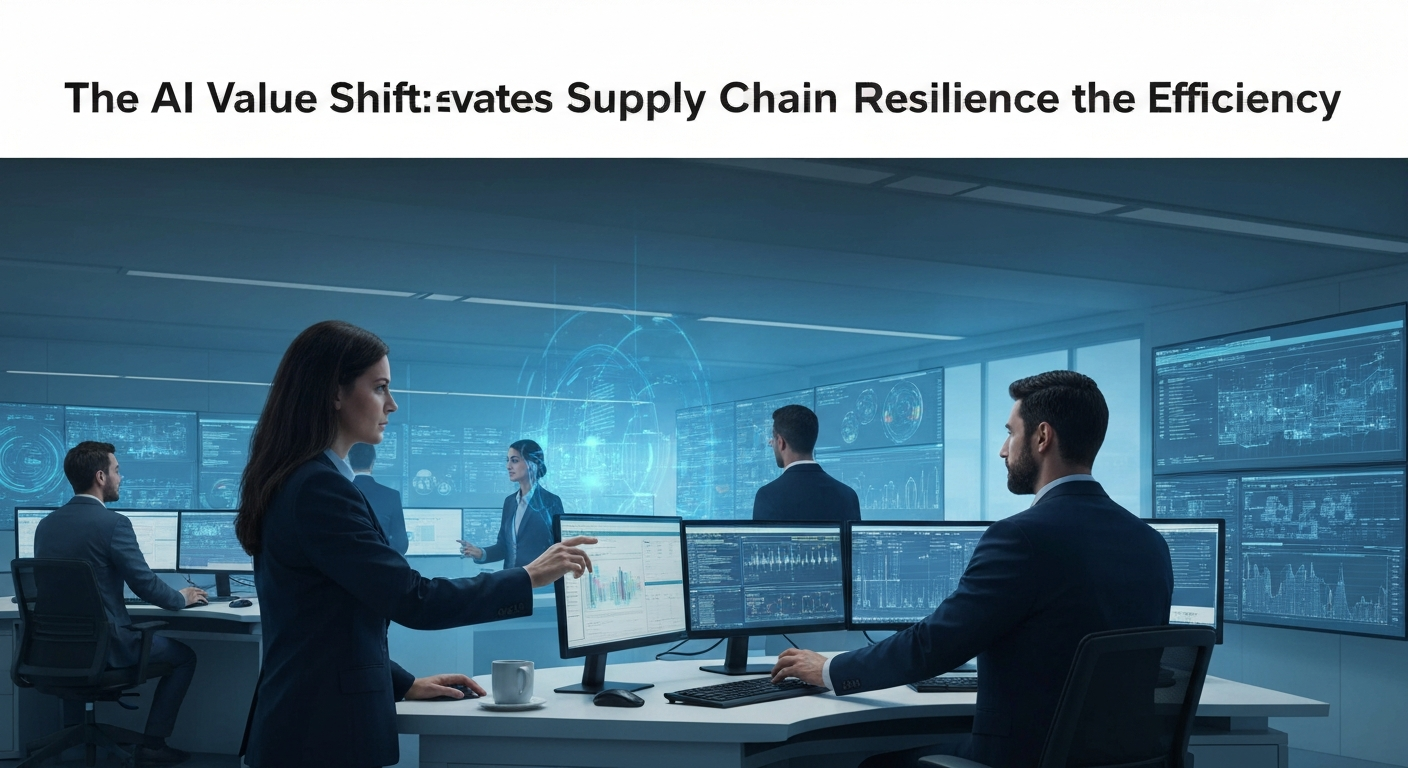
How this impacts the global supply chain
As the underlying costs of AI models become more accessible, the impact on global supply chains will be profound, shifting the focus from simply having AI to how it's integrated and leveraged. This evolution will fundamentally alter global supply-chain flows, capacity utilization, and operational paradigms.
Regarding flows and routes, cheaper AI democratizes basic optimization capabilities. However, the real differentiation will emerge from platforms that can integrate deeply and provide rich, contextual data. This enables hyper-dynamic routing, where traditional static plans give way to real-time adjustments based on micro-disruptions like traffic incidents, port congestion, or adverse weather, as well as macro-shifts such as geopolitical events or new trade agreements. The result will be less predictable but ultimately more efficient and resilient global movement of goods, as routes continuously adapt to optimize for speed, cost, and risk.
In terms of capacity, AI's role will evolve beyond simple forecasting to proactive, predictive management. With a focus on "workflow ownership" and "execution authority," intelligent systems will dynamically reallocate resources, optimize container stuffing, consolidate shipments more effectively, and even predict equipment maintenance needs to prevent costly downtime. While this doesn't create new physical capacity, it significantly enhances the utilization of existing assets across all modes of transport – from ocean vessels and air freight to trucking fleets and warehousing space – thereby improving overall network efficiency.
For operations, the shift is from reactive problem-solving to proactive, and increasingly, prescriptive management. AI, deeply embedded within operational workflows, will automate routine decisions, flag anomalies before they escalate into critical issues, and offer precise, actionable recommendations. This will streamline every aspect of logistics, from inventory management and warehousing to last-mile delivery, demanding a higher level of data integrity and system interoperability across the entire supply chain. The global supply chain will become more agile and responsive, albeit with increased complexity in its underlying digital architecture.
Global financial impact
The evolving landscape of AI affordability and differentiation carries significant financial and cost implications for all stakeholders in global trade: shippers, carriers, and the broader trade environment.
For shippers, the initial allure of reduced AI costs might suggest immediate savings. However, the true financial gains will materialize from investing in platforms that offer the deeper differentiation points: comprehensive workflow ownership, rich data context, robust integration depth, and decisive execution authority. This translates into substantial cost reductions through optimized transportation networks (leading to lower freight costs and reduced reliance on expedited shipping), minimized inventory holding costs (due to more accurate demand-supply matching), and fewer penalties stemming from delays or non-compliance. The return on investment (ROI) for shippers will be realized by proactively avoiding the often-hidden costs of inefficiency, disruption, and missed market opportunities.
Carriers face a clear financial imperative: leverage advanced AI to maximize asset utilization and operational efficiency. Deeply integrated AI solutions can optimize network planning, significantly reduce empty miles, improve fuel efficiency through smarter routing algorithms, and enhance predictive maintenance schedules to prevent costly breakdowns. This directly leads to higher profitability per asset and a more competitive service offering in a crowded market. To fully capitalize on these benefits, carriers must invest in robust data infrastructure and integration capabilities, moving beyond isolated AI tools to comprehensive, intelligent operational systems that can orchestrate complex logistics processes.
For trade at large, the overall financial impact will be a reduction in friction and transaction costs across the global economy. More efficient and resilient supply chains will lower the cost of goods, potentially stimulating consumer demand and fostering new trade relationships. Countries and regions that embrace advanced digital infrastructure and readily adopt deeply integrated AI solutions will gain a significant competitive advantage, attracting more trade and investment. Conversely, those that lag in digital transformation risk becoming less competitive due to higher operational costs, increased vulnerability to disruptions, and a diminished capacity to participate in the evolving global marketplace.
How MGS can help navigate today's global trade environment
MGS, as a cutting-edge shipment-visibility control tower, is uniquely positioned to help operators navigate and thrive within this evolving landscape of AI differentiation. Our platform directly addresses the core tenets highlighted by the shifting AI paradigm, providing tangible benefits where they matter most.
Firstly, MGS excels at providing Data Context. We aggregate disparate data points from across the entire supply chain – including carriers, ports, customs agencies, internal enterprise resource planning (ERP) systems, and IoT devices – and transform them into actionable intelligence. This means raw data is not just presented, but contextualized, offering a holistic, real-time view of every shipment. AI models, whether MGS's own advanced analytics or integrated third-party tools, thrive on this rich, contextualized data, enabling them to make more accurate predictions, identify anomalies, and offer more precise recommendations.
Secondly, our platform is built on a foundation of deep Integration Depth. MGS seamlessly connects with a vast ecosystem of partners and systems, ensuring fluid data flow and effectively eliminating information silos that often plague complex supply chains. This robust integration depth is precisely what enables AI to support and inform "workflow ownership" by providing a comprehensive, end-to-end understanding of the entire process, from the initial order to final delivery. Without this deep integration, AI's insights would remain fragmented and less impactful.
Thirdly, while MGS doesn't physically move goods, it provides the intelligent layer that supports and guides Workflow Ownership. By offering unparalleled real-time visibility and predictive analytics, MGS empowers operators to proactively manage exceptions, automate decision-making based on predefined rules, and even trigger alternative actions (e.g., rerouting, re-prioritizing shipments, or adjusting inventory plans) when disruptions occur. This moves beyond mere data presentation to enabling informed, decisive action, laying the groundwork for greater execution authority within the supply chain by providing the intelligence needed to act swiftly and strategically.
Finally, in an environment where global trade is increasingly volatile, MGS provides the crucial real-time intelligence needed for effective Responding to Disruptions. When an unforeseen event occurs – be it a port delay, a severe weather event, or a customs hold-up – MGS immediately flags the affected shipments, assesses the potential impact across the network, and, leveraging AI, can suggest optimal alternative solutions. This allows MGS users to maintain continuity, minimize costs associated with delays, and uphold customer commitments, effectively transforming potential crises into manageable challenges through proactive intervention.
Demand–supply analysis & improvement
The shift in AI differentiation directly impacts the precision and agility of demand-supply matching within global supply chains. The emphasis on "workflow ownership, data context, integration depth, and execution authority" provides powerful levers for significant improvement in this critical area.
For enhanced demand sensing, deeper data context and robust integration allow AI to ingest and synthesize a wider array of real-time demand signals. This includes granular point-of-sale data, dynamic e-commerce trends, macroeconomic indicators, and even sentiment analysis from social media. By processing this diverse information, AI can generate more granular and accurate demand forecasts, significantly reducing the bullwhip effect and optimizing inventory levels across the entire supply network. This proactive understanding of demand minimizes both overstocking and stockouts, leading to substantial cost savings and improved customer satisfaction.
Regarding dynamic supply response, the concepts of "workflow ownership" and "execution authority" enable supply chains to react with unprecedented agility. If demand suddenly spikes or dips, AI-driven systems can instantly re-optimize production schedules, adjust inventory allocations across warehouses, and modify transportation plans to match the new reality. This represents a fundamental shift from static, periodic planning cycles to a continuous, adaptive supply response. Such agility ensures that supply can be rapidly reconfigured to meet fluctuating demand, minimizing lost sales due to unavailability and reducing waste from excess inventory.
To truly capitalize on these opportunities, improvement levers must focus on implementing platforms that offer end-to-end visibility and deep integration, rather than relying on isolated AI tools. The strategic imperative is to create a unified data fabric that feeds intelligent decision-making across the entire demand-supply spectrum. This includes investing in robust data governance to ensure data quality, ensuring interoperability between all systems, and empowering AI with the appropriate level of authority to trigger actions based on real-time insights. The ultimate goal is to foster a self-optimizing supply chain that can dynamically balance demand and supply, even amidst the inherent volatility of global trade.
ROI-focused resilience
Building resilience in today's complex global trade environment is no longer merely about mitigating risk; it's about making strategic, measurable investments that yield a clear return. The evolving AI differentiation, particularly its focus on "workflow ownership, data context, integration depth, and execution authority," provides a robust framework for achieving ROI-focused resilience.
An investment in proactive risk mitigation through platforms with deep integration and contextual data allows for the early identification of potential disruptions. For instance, by integrating real-time geopolitical intelligence with precise shipment tracking data, a company can identify shipments at risk of customs delays or port closures weeks in advance. The ROI here is the quantifiable cost of disruption avoided – preventing a single container from being stranded could save tens of thousands in demurrage charges, expedited shipping fees, and potential lost sales due to stockouts. This proactive approach transforms potential liabilities into measurable savings.
Furthermore, the ability to quantify the cost of inaction becomes paramount. Without advanced AI capabilities and deep visibility, the financial repercussions of supply chain disruptions can be staggering: lost revenue, damage to brand reputation, increased operational expenses (e.g., relying on expensive air freight to recover schedules), and contractual penalties. By implementing a system with execution authority, a company can precisely quantify the risk of a specific disruption (e.g., "a 3-day port strike on this particular route impacts 10% of our Q3 revenue") and subsequently measure the ROI of the AI-driven intervention that mitigates or even prevents it. This allows for a clear financial justification for resilience investments.
MGS's role in driving ROI-driven resilience is foundational. Our platform provides the essential visibility and data context necessary for accurate risk assessment and ROI calculation. By offering a single, authoritative source of truth for all shipments, MGS enables AI to accurately assess the potential impact of various disruptions. Moreover, MGS's capacity for deep integration and its ability to provide actionable insights empower operators to make data-driven decisions that directly protect against identified and quantified risks. This ensures that investments in resilience translate into tangible financial benefits rather than just abstract security, shifting the strategic conversation from hypothetical "what ifs?" to a clear understanding of "what is the cost of not acting, and what is the measurable return on this proactive investment?"
Source: Logistics Viewpoints — https://logisticsviewpoints.com/2026/07/09/as-ai-becomes-more-affordable-supply-chain-software-differentiation-moves-up-the-stack/