
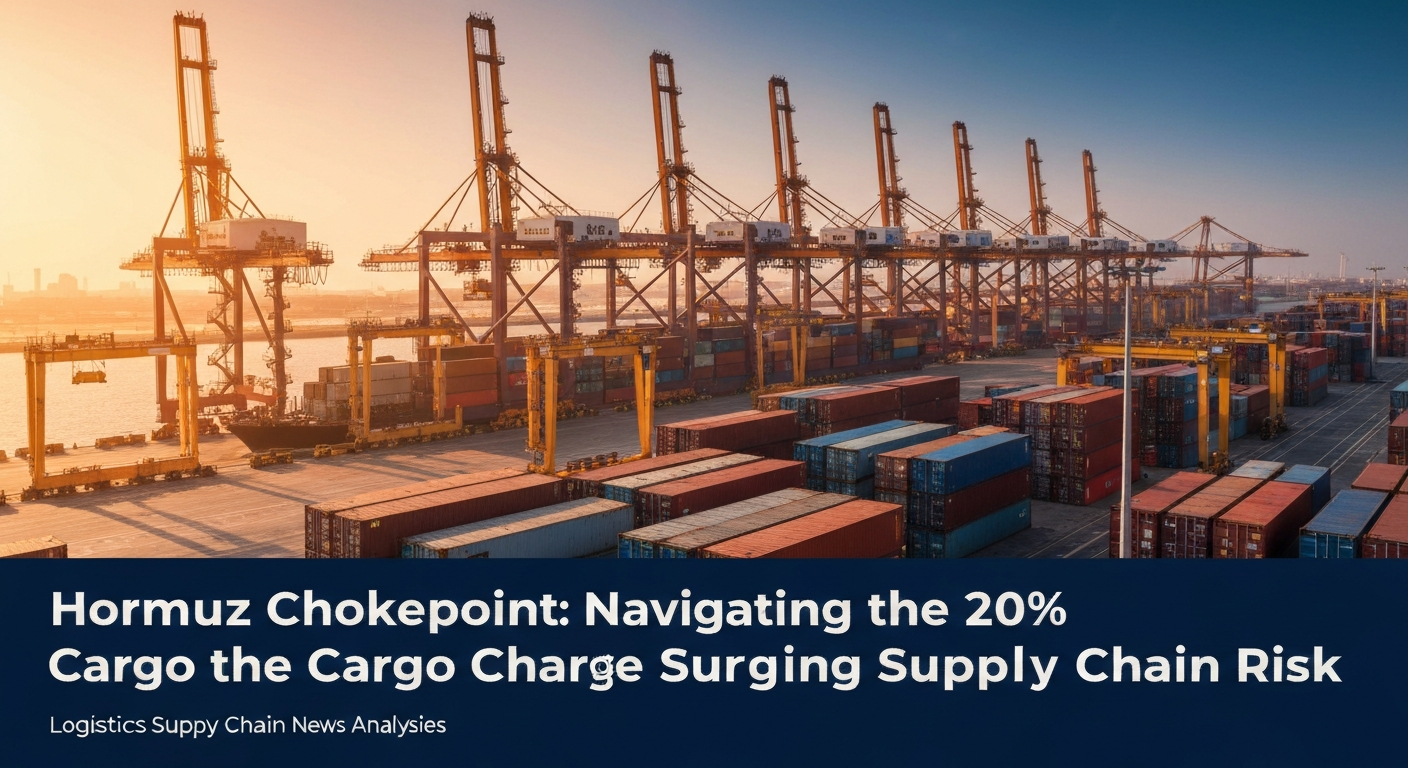
Hormuz Chokepoint: Navigating the 20% Cargo Charge and Surging Supply Chain Risk
President Trump's proposed 20% cargo charge for Strait of Hormuz transits marks a critical escalation in global trade costs and risk. This brief analyzes the profound implications for supply chain flows, financial stability, and how advanced visibility platforms like MGS are essential for resilience in this volatile new environment.
How this impacts the global supply chain
The proposed 20% cargo charge for transiting the Strait of Hormuz, amidst heightened security operations, fundamentally reshapes global supply chains. This critical choke point, vital for global energy and trade, now carries a direct, substantial cost.
Global supply-chain flows face immediate disruption. Shippers must re-evaluate existing lanes, especially for energy commodities where the Strait is indispensable, leading to higher prices throughout the supply chain. For other goods, the 20% increase might render current sourcing uneconomical, prompting a search for alternatives.
Routes could shift, though options like rerouting around the Cape of Good Hope add thousands of nautical miles, significantly increasing transit times, fuel consumption, and costs. This extended duration directly impacts capacity, as vessels are tied up longer, reducing effective global shipping availability. This capacity crunch would further amplify freight rate volatility.
Operations will contend with unprecedented planning complexities. Supply chain managers must integrate this substantial tariff into lead times, inventory strategies, and supplier relationships. Just-in-time models, particularly for industries reliant on Middle Eastern inputs, will face severe pressure. Companies must quickly decide whether to absorb the 20% cost, pass it on, or fundamentally alter their networks, all while navigating "surging shipping risk." Agile decision-making and robust contingency planning are paramount for continuity.
Global financial impact
The 20% cargo charge at the Strait of Hormuz represents a profound financial shockwave for the global economy, impacting shippers, carriers, and international trade.
For shippers, the 20% surcharge is a direct, massive increase in landed costs, particularly for high-value goods and bulk commodities like oil. This cost will inevitably be passed down, resulting in higher prices for raw materials, manufactured goods, and consumer products, fueling inflation and potentially squeezing profit margins. The "surging shipping risk" will also lead to sharply increased marine insurance premiums, adding another layer of expense and uncertainty.
Carriers will face significant adjustments. While they may pass on the 20% charge, their operational costs will also rise due to increased security, potential rerouting (higher fuel/longer transit), and elevated vessel insurance. Uncertainty around the charge will complicate long-term contracts, leading to volatile spot market pricing and potential shifts in demand as shippers seek alternatives.
For trade at large, the ramifications are systemic. As a critical artery for energy, a 20% charge on oil and gas will trigger substantial global energy price increases, impacting all sectors and households. This could slow economic growth and exacerbate geopolitical tensions. The "new uncertainty" for supply-chain planning will deter investment and complicate long-term strategies, making international commerce more expensive and less predictable.
How MGS can help navigate today's global trade environment
In an environment of "surging shipping risk" and a potential 20% cargo charge at a critical chokepoint, real-time, end-to-end shipment visibility is essential. A platform like MGS, a shipment-visibility control tower, becomes invaluable.
Firstly, MGS provides unparalleled situational awareness. As U.S. forces secure the Strait and the 20% charge looms, operators need to know precisely which shipments are currently traversing, or scheduled to traverse, this high-risk zone. MGS offers real-time tracking, allowing instant identification of affected cargo, its location, and immediate exposure to the new levy or security threats, crucial for rapid response.
Secondly, MGS facilitates proactive decision-making and scenario planning. With comprehensive visibility, MGS can model the financial impact of the 20% charge on specific cargo and routes. This enables supply chain teams to quickly evaluate alternative routes, comparing their total landed cost against the Hormuz surcharge. For example, quantifying if rerouting around the Cape of Good Hope (adding transit time and fuel cost) is more economical than paying the 20% charge.
Furthermore, MGS enhances operational agility and resilience. Should rerouting become necessary, MGS provides real-time updates on new estimated arrival times, allowing downstream operations to adjust schedules. It helps manage customer expectations with accurate delivery information, minimizing the impact of delays or cost increases. MGS acts as a single source of truth, consolidating data, reducing "new uncertainty" in supply-chain planning, and enabling coordinated responses to evolving trade conditions.
Demand–supply analysis & improvement
The proposed 20% Hormuz cargo charge, against a backdrop of "surging shipping risk," significantly disrupts demand and supply dynamics, particularly for energy and related sectors. This introduces substantial friction into global trade.
From a supply-side perspective, the 20% charge functions as a direct cost shock, effectively reducing the economically viable supply of goods transiting the Strait. For energy, this translates to higher production costs and market prices. While physical supply might not immediately decrease, its accessibility and affordability are severely impacted. The "uncertainty for energy, shipping, insurance, and supply-chain planning" further constrains supply as businesses become cautious, potentially delaying investments or reducing output. Reduced effective shipping capacity from potential rerouting also physically limits goods movement, tightening supply.
On the demand side, the price increases driven by the 20% charge will cause some demand destruction, especially for price-sensitive goods. However, for essential commodities like oil and gas, short-term demand is relatively inelastic, meaning higher prices will largely be absorbed, leading to inflation rather than significant consumption drops. Conversely, uncertainty might also trigger precautionary demand, with businesses building safety stock against future price hikes or disruptions.
To improve this dynamic, concrete levers include:
- Supply Chain Diversification: Actively qualifying alternative suppliers not reliant on Hormuz, reducing single-point-of-failure risk.
- Route Optimization & Multimodal Exploration: Investing in analyses for viable alternative transportation routes (e.g., land bridges), offering resilience despite potential higher costs.
- Strategic Inventory Management: Adjusting safety stock for critical components transiting the Strait, moving towards a more resilient, capital-intensive approach to buffer shocks.
- Demand Forecasting with Cost Volatility: Integrating significant cost increases into models to better predict shifts in purchasing patterns.
- Long-term Energy Transition: Accelerating investments in renewables to reduce reliance on geopolitically sensitive fossil fuel regions.
ROI-focused resilience
The "surging shipping risk" and the proposed "20% Hormuz cargo charge" present a clear, quantifiable threat to profitability, making resilience investments an ROI-driven imperative. Framing these actions by measuring return against potential losses is key.
Consider the direct financial exposure: a company shipping $500 million of goods annually through Hormuz faces an additional $100 million in direct costs from a 20% charge. This is a tangible risk for resilience investments.
-
Investment in Advanced Shipment Visibility (e.g., MGS): The ROI is derived from avoidance and mitigation. MGS enables instant identification of affected shipments, modeling the 20% cost, and exploring alternative routes. If MGS helps reroute just 5% of that $500 million cargo, avoiding the $100 million charge on that portion, it saves $5 million. Beyond direct cost avoidance, MGS prevents costly delays, demurrage, and lost sales, which can easily total millions. The platform's annual cost can be quickly offset by mitigating a fraction of potential losses from this single charge, let alone other disruptions.
-
Strategic Inventory Buffering: Investing in higher safety stock for critical components reliant on Hormuz transit. If a production line halts due to a missing $10 component, costing $1 million per day in lost revenue, holding an extra month's supply (e.g., $300,000 in holding costs) offers clear ROI by preventing downtime. The 20% charge could make replenishment prohibitively expensive or slow, making pre-positioned inventory invaluable.
-
Supplier and Route Diversification: The cost of qualifying new suppliers or establishing alternative routes is significant. However, if a single-source supplier relying on Hormuz becomes unviable due to the 20% charge or security risks, the cost of a complete supply chain breakdown (e.g., billions in lost revenue, brand damage) far outweighs the diversification investment. For instance, a 5% incremental unit cost for a secondary supplier covering 10% of volume is a small premium for insurance against catastrophic disruption.
Source: Logistics Viewpoints — https://logisticsviewpoints.com/2026/07/13/trump-proposes-20-hormuz-cargo-charge-as-shipping-risk-surges/